The Crossroads of Time and Space
Their meeting symbolizes the four directions of any journey: through time and space. From past to future, from east and north to west and south.
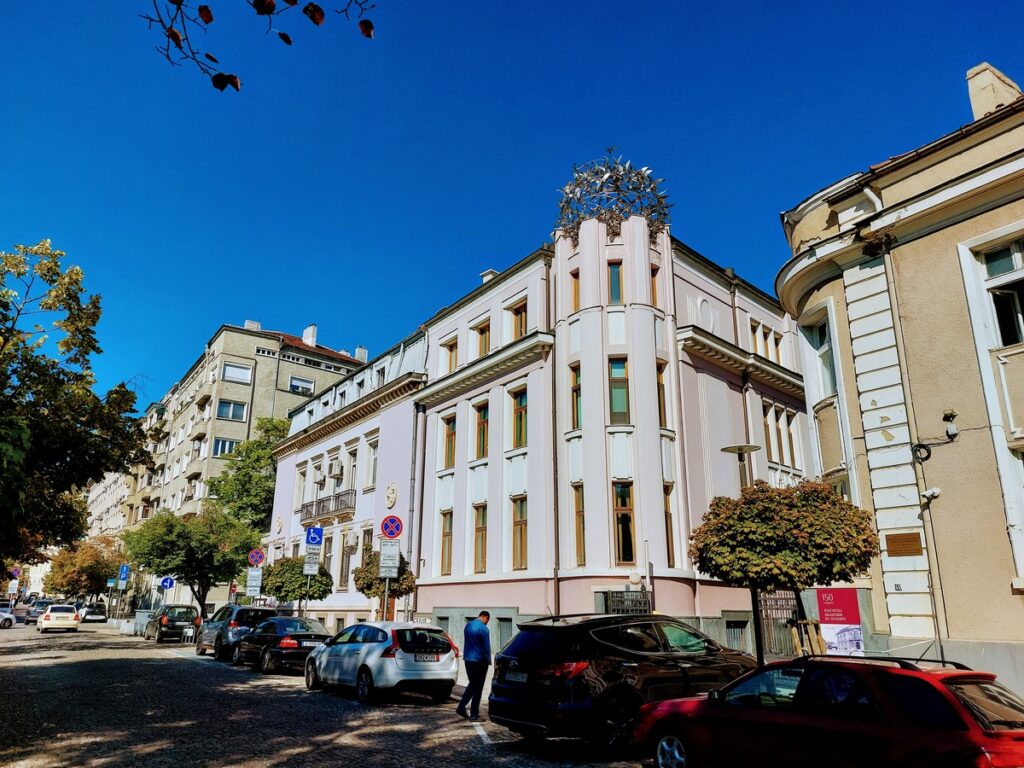
Rakovski Street, long and diverse, crosses the city center from north to south. At its northern end, it solemnly fades away by the fences of several embassies, while at its southern end, it flows into the chatty everyday life of the suburban neighborhood.
It seems to offer everything Sofia has – administrative buildings, banks, a hospital, museums and theaters, schools, and shops. Pedestrians hurry along its sidewalks, trolleys ring nearby, and cars cough hoarsely amidst another traffic jam. The street is laden with everyday life, and its inhabitants rarely think about its true value and its significance in the capital's life.

On Rakovski Street towards Moskovska„
Passing the envisioned statue of Yavorov and crossing Slaveykov Square, it smoothly flows towards „The Theatre Academy.“ In front, several students are flirting, smoking, and secretly dreaming of their star moments as actors. Years later, a bit further on, in the theaters, they will receive their first lessons on facing audiences and the vicissitudes of an artistic career.
In the small.
After that, the street takes a breath and heads uphill, nodding to the right towards the Military Club with its seemingly opulent, yet somehow stern facade, giving a slight wink to the Russian Church and its dome, which glinted behind the weeping willow in front, and is now ready for one of its most important intersections.
The meeting of the two streets
When „Rakovski“ meets „Moskovska,“ it quiets down, trying at least a little to appear official and dignified for its meeting with the old lady of Sofia's streets.
On „Moskovska“ Street, people rarely hurry. The beautiful buildings and historical monuments calm the vanity and impose a solemn rhythm on city life. The employees of the Municipal Council slow down the clicking of their heels, and children play quietly in the small garden. Even the two parliament members from different parties, who have escaped like schoolchildren from the National Assembly sessions, amicably smoke their thick cigars in the corner cafe and try to remember why, for God's sake, they were arguing a moment ago.
If they are there, only the tourists are loud. These eternal hooligans of the world are ready to see everything, photograph it, forget it, and then wave their sweaty t-shirts at the next attraction.
Sometimes it's noisy and newlyweds who love to come for their wedding photos nearby. The brides' white dresses caress the pavement slabs, dizzy guests pose with awkward smiles, and photographers try to calm all the fuss, aiming their long lenses.
Here „Rakovski“ and „Moskovska“ meet, embrace, and then separate again. Just as, probably, the ancient roads of Serdica, and then the dusty Ottoman roads, crossed right beneath them. If we stand here quietly and calmly, we can feel the pulse of the place where people have met for centuries.
Perhaps it will be the same in the future. We will always travel in the four directions of the world, cross our paths, and in the soul of some city, we will leave the imprints of our actions, ideas, and hopes.

The Bulgarian poet
The gravestone of Ivan Vazov
The cooper's name is somewhere in the historical archives, and conscientious historians have long sought it out. But let's call him Dimitar.
After so many years spent among the buffaloes, Dimitar had unconsciously begun to resemble them. Stocky and heavy, he spoke little, deliberating over every word. People instinctively feared him, as if his contained phlegmatic strength could suddenly awaken and furiously dispense justice or vengeance.
The rain had just stopped drizzling, but clouds were gathering to the west of Vitosha, and one of them, the darkest, the most looming on the horizon, worried Georgi. If the sky continued to pour its moist blessing on the Shopi fields, movement would become even more difficult.
The buffaloes were already pulling the cart slowly. They flexed muscles under their thick hides, their white foreheads bowed stubbornly downward, and they barely glanced to the side. They knew they had nothing to fear. No animal, not even one driven mad by hunger or fear, would attack them. Nor would a human disturb the monotonous rhythm of their steps. It was as if they were sacred.
Only Dimitar was their master. He could drive them, stop them, scold them, and even hit them. And they obeyed him, especially then, as if they understood their mission during those days.
He first patted the flank of the first of the six buffaloes with his palm, more imploringly than angrily. Then he went back to the truck with the scale. This enormous ten-ton stone barely budged at the foot of Vitosha, having struggled to break free from the mountain's natural embrace, on its way to the city center.
Dimitar leaned against the moraine and tried to push it forward, in the vain hope of helping the buffaloes. He was in a hurry. This piece of granite, smoothed by millennia of glaciers, covered in moss and lichen spots, had to arrive in Sofia as soon as possible.
The grave of a poet awaited him there. A man who had managed to instill in the soul of his people something as powerful as the noble might of buffaloes, as wise and good as a craftsman's love for his work, and as timeless as Vitosha's moraine. Ivan Vazov.

The grave and the monument
Today the stone lies partially sunk in the soft earth, and the humble inscription on it invites visitors to stoop to read it. Thus, willingly or unwillingly, everyone bows their head before this memorable place.
Ivan Vazov passed away on September 22, 1921, at the age of 71. In 1926, the transfer of the Vitosha granite was organized. For this purpose, a four-kilometer road was built, along which six buffaloes pulled the cart with the 2.5-meter-high and 1.5-meter-wide stone for 18 days.
The monument to Vazov was erected in 1956 in the small garden in front of the „St. Sofia“ church, while his grave is to the side, behind the red wall of the church building, and is modestly sheltered under a few trees.
So, on Georgi Rakovski Street it's as if his whole life, his home, grave, and monument are there.

The beginning is the word.
So much has been said and written about Ivan Vazov, from academics in their dusty studies to children behind desks in classrooms, that it's almost sacrilegious to presume to share something of our own. Nevertheless, let us dare.
I believe, without the self-importance of a discoverer, that the significance of his work is not exhausted solely by the number and volume of his diverse creations, which are impressive in themselves.
Every national culture needs two foundational books, like the „Iliad“ and the „Odyssey“ for European literature. They are that complex set of ideas, values, plots, and maxims that is the eternal source of the national spirit.
When Ivan Vazov wrote „Under the Yoke,“ he didn't just create a novel, even though it's read and loved by all Bulgarians. It's a book with a far greater significance than any, even a brilliant, novel. This work is the Bulgarian „Iliad,“ which educates and shapes the millions of inhabitants of this territory precisely as Bulgarians. Even if we haven't read it, even if we've forgotten the plot and characters, we live in its beneficial shadow, and our national consciousness is permeated by it.
This is not a novel, it is the beginning and the eternal life of the feeling of being Bulgarian.
Isn't it always the word in the beginning.

See more about Author Darina Vankova here
The gallery from Sofia's iconic intersection.