Reflections, insights from Central Europe
If you accidentally missed the previous parts of the series
„Mysteries of Central Bulgaria“, take a peek here:
Part One: Mysteries of St. Nedelya. Koprivshtitsa: Archaeology of the Spirit
Second part: Koprivshtitsa – Archaeology of the Spirit 2
Third part: Bogdan Peak, a gift from the god Bog in Central Bosnia
Fifth, final part: Goat grumadi
The road through Central Moravia to Starosel
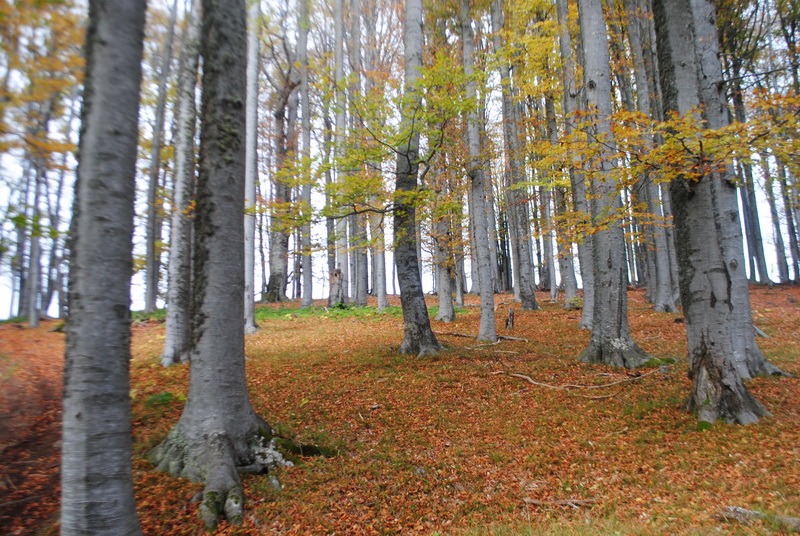
The morning is humid and cold. We are heading south through dense mixed forest.
We pass by the four-story Chivira hut, which seems to have been devastated by war, the former rest house of the military factories in Karlovo.
From the end of the forest, the building is viewed from a huge distance.
A flat field the size of several Olympic stadiums. In the middle of it, a former MiG fighter jet has landed in a surrealistic way. It was once placed there for entertainment purposes.
to the numerous visitors. The deserted human habitat acts oppressively.
I imagine the children playing the orkies, the mountain climbers, the evening fires, I hear the music and laughter, the clinking of dishes in the huge dining hall, muffled by the distance and the darkness of the speech. From the broken pipe at the entrance flows a powder-strong stream of water. This is the only thing that moves, emphasizing the desolation of the senseless devastation.
I continue towards Starosel
The car bounces on the first and second surfaces of the road
from large gravel. With a stranger it might be faster. Here and there I let go of the small remnants of asphalt so that I can bite down even harder when they are quickly used up. Along the road and on all the slopes of the mountain there is a pile of rubble made of wood logs or smaller cut firewood.
The erosion of human greed and spirituality
Poverty on a national scale slowly but surely devours the wondrous green mantle of the mountain. Its shadows, filled with wonders, shrink and contract like a river drying up in the desert. Far from the eyes of people, a secret mass murder is being carried out. I wonder what I get more of here – joy or torment.
The soul is drowning in a swirling whirlpool.
I swear that if I have the power, I will ban it
I rush to leave the empty battlefield where marauders are killing the wounded.
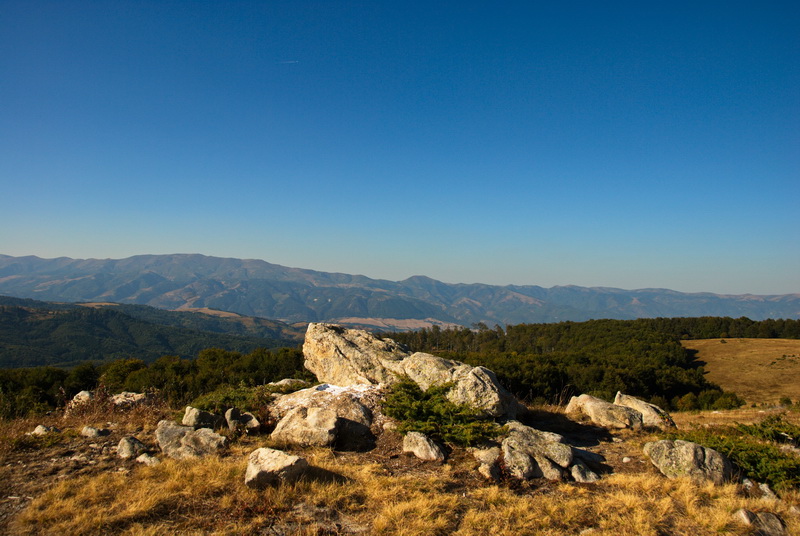
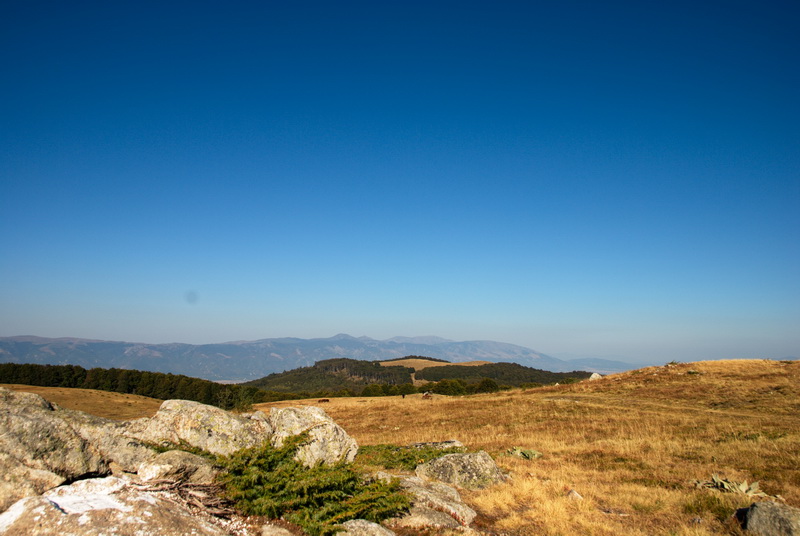
After about an hour, just before Starosel the wide, sparkling southern horizon Thrace It warms the eyes and dispels the mental exhaustion accumulated in the severely wounded forest.
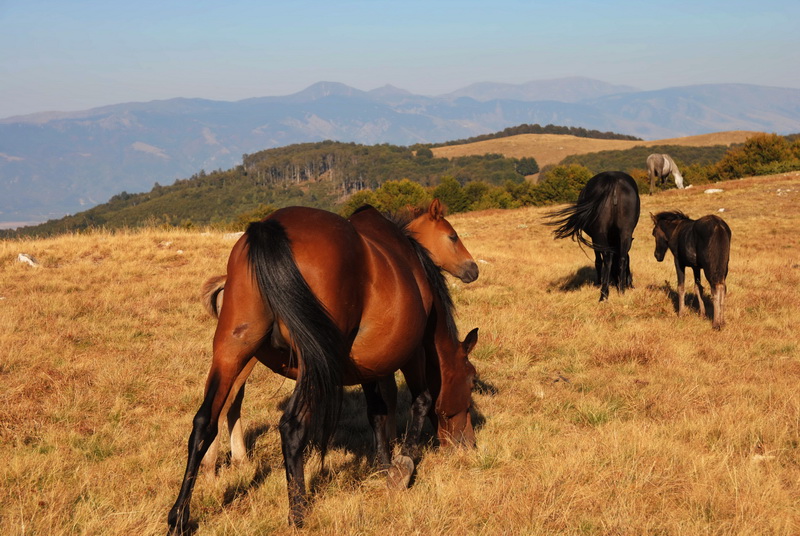
Chetinyo grave — the temple of the Thracians
About five kilometers before the village, a car and
The bodies are being removed with relief on the asphalt. Almost immediately we come across the parking lot below. Chetinyo grave, In whose depths for millennia one of the most impressive wonders of the ancient Thracian culture has been created.
The temple was hidden for centuries under a high mound and
It occupies the most representative place among the royal residences at the foot of the mountain. From here, the gaze sweeps across the entire plain and easily absorbs everything that comes within its reach.
The scale of the sanctuary, and subsequently
The royal tomb, as well as the numerous ritual elements around it, define it.
as a cult complex of central importance for the entire Central Mountain region. A 240-meter circumference, 20 meters high, 5,000 stone blocks built, each weighing about half a ton, connected with metal clamps sealed with lead, are the starting points for the measurements. A monumental entrance has been revealed in the southern face of the mound.
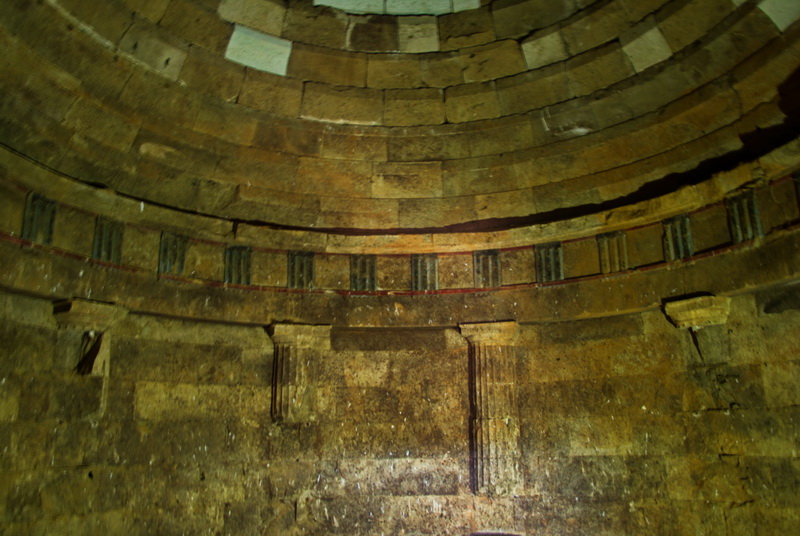
An imposing stone staircase leads to the interior. Behind it, a majestic corridor, ten meters long and six meters wide, rises at an incline.
to the entrance hall.
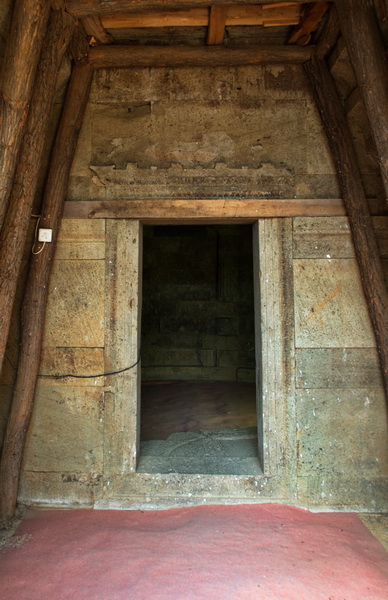
The architecture and symbolism of the Thracian temple
The visitor's soul is squeezed from the sides
Five-meter walls, roughly carved with raw beauty. Brought under convoy to the facade of the vestibule, the gaze is drawn by the soft radiance of fine
The smooth and perfectly arranged blocks of greenish volcanic tuff.
The awe-inspiring effect of this ascending gradation, leading the subjugated senses upward and inward, so prepared for the solemn culmination in the temple chamber, is masterfully orchestrated.
The material of the facade is carefully selected,
It was mined at no less than twenty kilometers, most likely from quarries near Strelcha.
The frugal, straight-line Doric style is evident
aesthetic, but even more refined and restrained, in a proportionately dignified and respectful way towards death. Before entering the sanctuary, the gaze is directed towards the altar.
It is completely offset by the gentle ornamentation on the frame of the entrance door. Three flat light strips from the opening prepare it for the ethereal plastic frieze, which consists of a thin chain of egg-shaped semi-ellipses arranged one above the other.
The free, elegant swing of his perfect arm
The design – a symbol of life and fertility, highlighted for dessert by a playful swirling band of meander, colored in red and blue, throws off playful optimistic notes in the impressive order of the enormous stones of the construction.
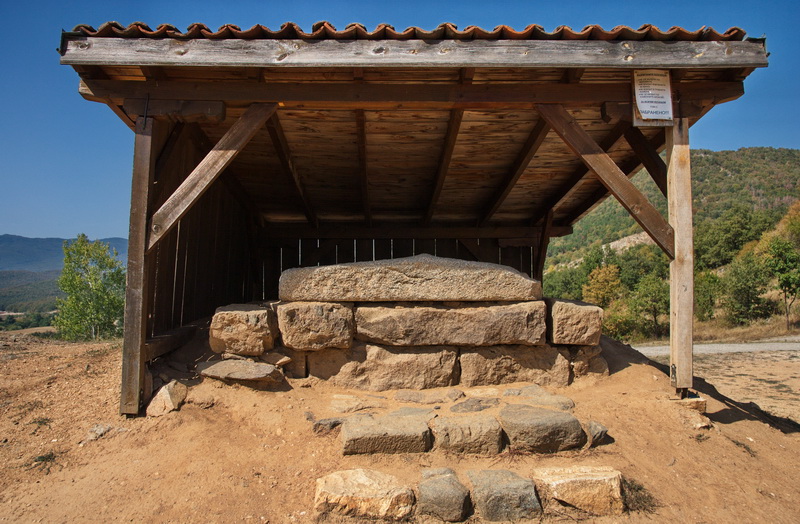
Death and life in the beliefs of the Thracians
Death and life in one whole, not dramatically
divided and polar opposite of each other.
Death for the Thracians, for whom the afterlife
Life was almost as vivid and real as the earthly one; it was not as oppressive and frightening as for the modern agnostic, superficial person who lives in a world of appearances.
It accepts with indifference to remain a dramatic coincidence in the miniature framework of its biology.
Despite being significantly shorter-lived
The duration of their journey on Earth, the ancients traversed it with vigor, more vibrant and full of life, as part of an uninterrupted river that flowed from and into the beyond, without interrupting or changing its strength.
Through a huge two-winged stone portal, after the vestibule and a second single-winged stone portal
The door was reached to the innermost part. Parts of the impressive doors, each weighing about seven hundred kilograms, were discovered; probably they were crushed ceremonially during the transformation of the temple into a tomb. The stone floor reveals deep arched grooves along which the doors – a stone imitation of wood with massive iron fittings – slid during the long use of the building as a temple.
The actual sanctuary is a circular room,
The stone cylinder is surrounded by ten carved pseudo-columns with capitals in Doric style. They seem to support the conical cap, the base of which is a double ring, finely engraved and painted with visible mineral paints in the main colors of the Thracian universal triad: the celestial kingdom – blue, the earthly life – red and the underground kingdom – black. According to the discoverer of the complex, Prof. Kitov, the circular cult room was subsequently converted into the tomb of the legendary king of Thrace.
the sirens of Sitalk.
Magnificence, simplicity and elegance that take the breath away with its grandeur, its technical and artistic perfection.
As if they realized that with this masterpiece, the ancient
Our ancestors closed a certain cycle; they achieved a culmination whose repetition was impossible or sacrilegious; they buried their great ruler in the heart of the temple and hid him in the earth forever as a sacrifice to eternity and its rulers – the gods; in this way the buried king, who alone is entitled to rule over this, was transformed and buried, inspired by themselves.
a creation.
It is inevitable to compare it to today’s man, whose greatness is measured primarily by the magnitude of his all-consuming curiosity and the crude appropriation of everything created before him.
Along with respect for the astonishing archaeological discoveries and the excitement of the millennia-old history, there also sneaks in the uncomfortable question that seems like a pebble in one's shoe – why despite the will of the people, the state is unable to provide the necessary resources to ensure the survival of the people?
Do the creators of this deliberately conceal what is intended to be hidden in an effort for sacred intimacy?
Do we have the right to transfer the bones and sacred memories of other people simply because they lived a very long time ago on the same land and their rights have expired due to some historical lapse of time?
only for the benefit of the living?
Vandals are a clear case. My question is about those who „scientifically“ dig with the support of society and the state. As if science and the insatiable need for proud exhibits for the national showcase make them less marauders and intruders?
There is something rotten about this and I don't feel comfortable. It may seem overblown, but I'm ashamed and I wish spontaneously to do something in memory of these people, to apologize somehow to them for me and the crowd rubbing our sneakers together and desecrating their altar.
Here is how the middle-mountain mess got mixed up,
located in Koprivshtitsa.
The list of misunderstood and probably offended grandfathers grew longer.
And while in such a mood, cautiously
I emerge alone from the darkness of the unlit interior of the underground, as if my frozen heart were breaking under the whisper – „Wait, wait! Where are you in a hurry?!“A invisible hand is resting on my shoulder… Hah, hah, hah! Funny, isn’t it?
After all, the pleasure and excitement in the atmosphere of this striking archaic beauty seem to outweigh the pangs of conscience and offer the consolation that the builders' shadows experience the ordinary human vanity of being admired by their masterpiece. And, you know, for a few thousand years, they might have been so bored that they would even be happy to see extraterrestrials, which we would undoubtedly be the ones to do them.
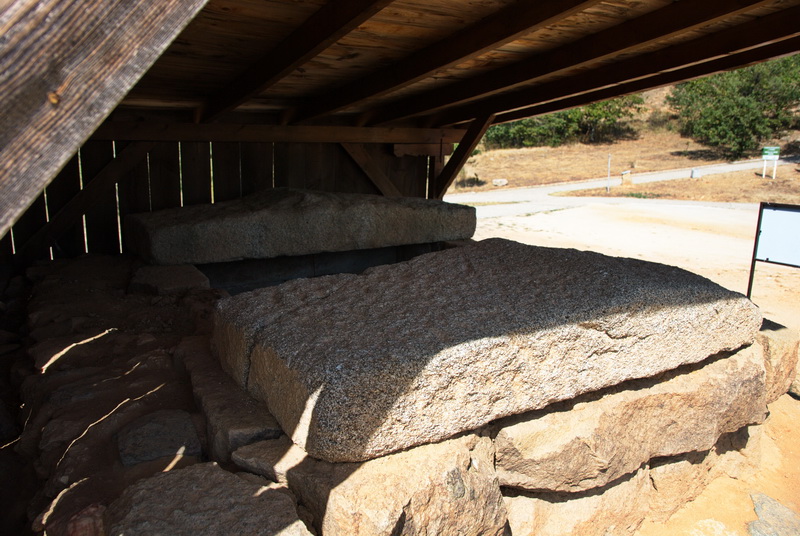
Chetinyo grave and Thracian ruling dynasty
The surroundings are densely dotted with similar objects,
which outline a religious center of a developed royal civilization.
The scale of the ancient Thracian presence here
They are significantly larger than in other places in the country. Even in the so-called Valley of the Kings near Kazanlak there is no such concentration. Many other religious artifacts have been discovered on Chetiynova Mound itself, proving that it is the epicenter of religious activity.
In the sacred territory meters from the cliff is
Another Thracian ruler was buried here; around it are discovered rock altars and sacrificial pits. In the highest part of the mound, from the northwest, there used to be a large wine cellar that has survived to this day. The use of wine, and not just symbolically, was widespread.
It invariably accompanied the sacred rites of the Thracians, which is why this solar religion naturally enjoyed a greater massiveness and frequency of the individual ritual sessions.
From archaeological facts to the spiritual message
I listen to the tour guides, read informational
I browse the internet, diving into information. The facts are infinitely interesting, but that diverts me from the contemplation that I find to be the appropriate state in every temple.
I struggle with descriptive, concrete language, I endure
I only partially agree with that, but in the end I prefer the alphabet of the poetic and symbolic. Science is primarily capable of scratching the surface of these things.
metaphysical mysteries, through his lifeless hollow terminology with a whiff of formalin, without reaching them.
And I am primarily in need of perceiving, retaining, and transmitting, insofar as possible, the impression, the suggestion, the excitement, and the pleasure. Of the influence they sought
the builders and the priests of these magical wonders. In a visible world, constructed entirely around the invisible as a worship of it.
No matter how material we are, whether we will feel satisfaction if we imagine someone, after thousands of years, digging only in our grave, in the remains and waste of our lives, taking on dimensions,
They judge and rank us solely based on them, and they do not ask what we thought, dreamed, what excited us, what we bowed down to?
Wouldn't we prefer that future someone to be
he tried to decipher the true message that the person sends to the world and to the generations that follow him, and which is written with the soul, not with the body and its functions.
tools?
The aesthetic superiority of the spiritualized
Ancientness stands in contrast to pragmatic modernity and is humbling. The emotions that overwhelm us here are similar to those found only in fairy tales and good adventure novels. Power and faith that are unknown now flow from the ancient stones.
What kind of inspiration is needed to erect such impressive and impactful monuments with bare hands?!
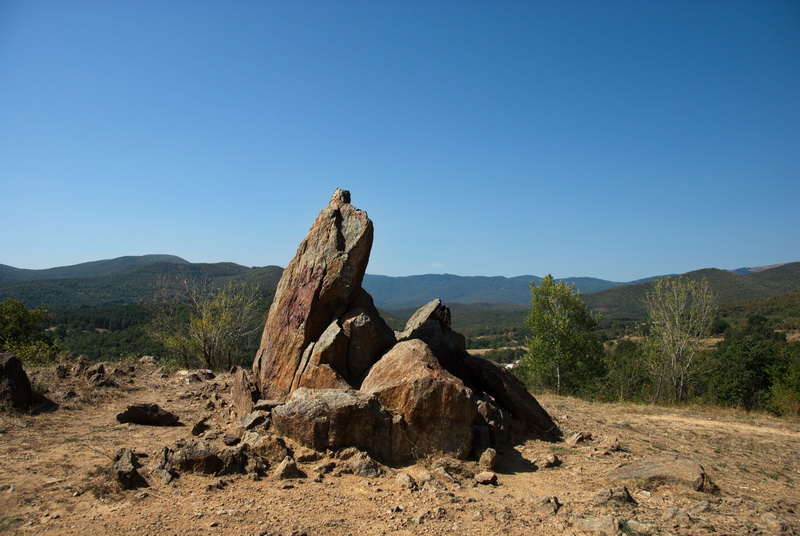
From Antiquity to Kozhi Gramadi
Then, following a spatial lyrical deviation into the depths of antiquity on our lands, the author Atanas Krestev embarks on a journey towards Goat grumadi.