I've wanted to share this story for a long time.
For the hospitable guesthouse, for the delicious dishes prepared by the Ali family, and for the village of Madrets in the Eastern Rhodopes.
I wonder what those kind people are doing now? Do they have a livelihood? How do they make ends meet?
But to start with the introduction, as we were taught...
One beautiful day, somewhere between late autumn and the approaching winter, we found ourselves in the Eastern Rhodopes. Magnificent sunshine, no wind, and beautiful views. Why is it that the legends in this region are always poetically tragic?
The Stone Wedding: Legends Come Alive
The Stone Wedding, also known as the Kardzhali Pyramids, is a geomorphological phenomenon of exceptional aesthetic value. It is located about 300 meters above sea level, 3 km from Kardzhali, near the village of Zimzelen. It was declared a natural landmark in 1974.
We admire the composition...
There are at least two options for the petrified wedding party..
An amorous young man is captivated by the blue eyes of a maiden from the neighboring village. Love ignites between the two young people, and they reach the cherished day to pledge each other's fidelity. But unfortunately – the wind blows the bride's veil, and the father-in-law catches a glimpse of her. A wondrous beauty. He desires her.
God saw through his impure thoughts and turned him to stone... And along with him: the two young men and the entire wedding party.
The other legend says, And the bandit leader spots the bride and decides to take her for himself. He demands a ransom. They don't give it to him. A battle ensues, in which the entire wedding party is killed again. The petrified sculptures are stained red with the spilled blood...
Let's go for a walk with photos to see the natural phenomenon.
Here are the newlyweds – forever petrified in a passionate kiss.
The wedding party, the happy couple themselves, and whatever your imagination conjures amidst the stone compositions, eroded by rain and wind, scattered and grouped across an area of approximately 50 decares.
The Stone Wedding It's a magical natural creation: a true symphony in white and pink, tinged with orange here and there.

Nature as a Great Sculptor
Seen from above, the rock formation resembles a disordered human crowd. Here are old and young, men and women, poor and rich, all dressed in white and pink ancient robes that reach the ground.
Some wedding guests watch from the sidelines, while others gather in groups. Flowers and mushrooms, various animals, slender columns, and obelisks enhance the festive feeling. The whole scene is lively and creates a cheerful mood.
The rock figures reach a height of about 10 meters.
How were these fantastic and beautiful shapes formed?
Once, about 35–40 million years ago, this part of the Rhodope Mountains was the seabed. As a result of underwater volcanic activity, rhyolitic tuffs were formed – a geomorphological mixture of various rock types, cemented by lava and volcanic sediments.
After the waters receded under the influence of the sun, wind, and rain, the bizarre rock formations gradually took shape, colored red, black, and ochre according to the chemical composition of the rocks.
And human imagination created beautiful images and legends...
A beautiful view unfolds before your eyes if you climb the steep path to the nearby peak. Along the way, there are sheepfolds and several rather unfriendly dogs, but luckily for us, they were tied up.
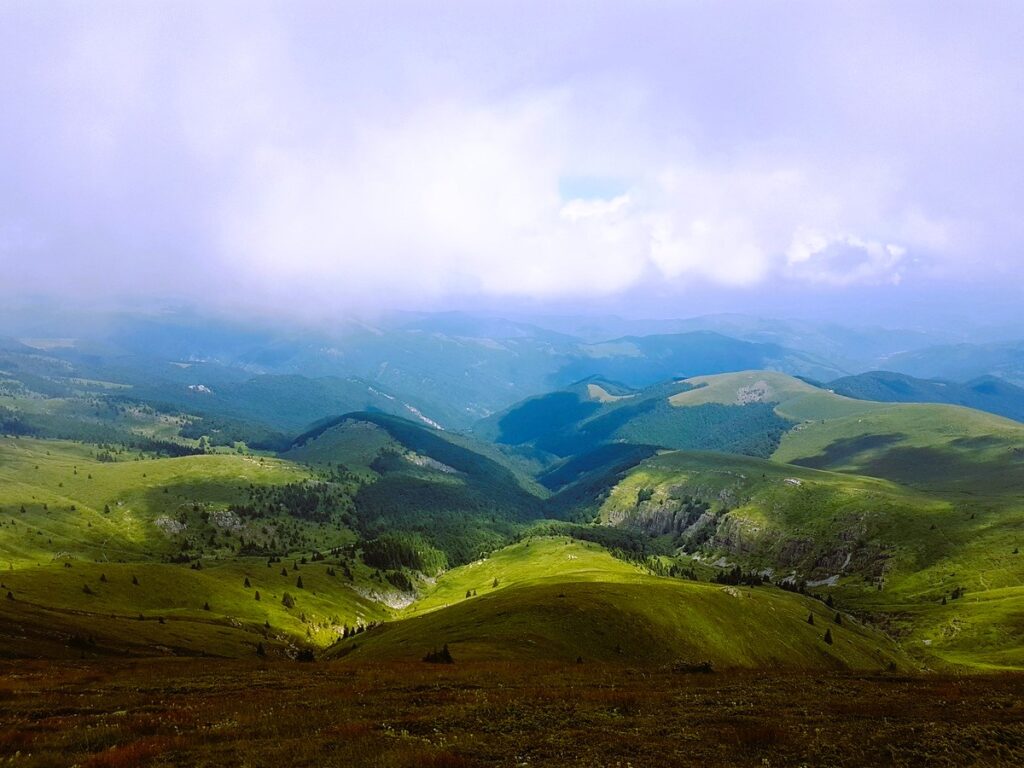
From the top, the view is clear as day. In this part, the Rhodope Mountains are soft hills covered with deciduous forests and shrubs. In the distance, the dark blue spot of a reservoir glints.
Unfortunately, civilization has „fenced off“ all the space with the iron skeletons of high-voltage wires...

Stone Mushrooms – Another Fairy Tale of Nature
We are off to the Stone Mushrooms. They are located east of the village of Beli Plast, on the road between Kardzhali and Haskovo.
The figures are a natural landmark in a protected area of about 3 hectares.
The rock formations have the shape of natural mushrooms – the stems are pink, and the caps are greenish. Their height reaches up to 2.5 meters. And they, like the Stone Wedding, are sculpted from rhyolitic volcanic tuffs.
How nature sculpted the Stone Mushrooms
Following the receding of the sea and the gradual rising of the seabed, erosion began.
The lower pink layer turned out to be softer and more easily succumbed to the effects of sun, wind, and rain. The upper greenish layer contains stronger minerals, mostly volcanic glass, and weathers significantly more slowly.
Thus, over millennia, nature has shaped this impressive composition of unique forms and colors.
The Legend of the Stone Mushrooms
Another sad legend. With different variations, but the ending is always the same... I chose this one for you.
The charcoal burner Raduil lived in the fortress Perperikon with his four beautiful daughters. One morning, the maidens went out of the fortress walls to fetch water. Suddenly, on the hill behind the river, they saw a large horde of invaders. They ran back into the fortress.
A fierce, unequal battle began. The men were slaughtered, and a large portion of the women were taken captive. Among them were Raduil's daughters.
They led them to the horde leader, who was mounted on a fine horse by the nearby river – to inspect the captives and to set aside the most beautiful for himself, and sell the rest as slaves.
As they approached, fury seized the hearts of the maidens. Together they grabbed whatever they could see – trees, stones – and began to throw them at the horseman. The horse was frightened, it reared up on its hind legs, and the rider fell to the ground. The four maidens rushed towards him and tore him apart.
These details horrify me! How did he tear it apart with his bare hands? The legend says nothing about this.
Then they fled into the nearby forest.
The faithful man of the leader cried out to pursue the maidens. At sunset, he caught up with them, swung his saber, and cut off the head of the first of them.
As soon as she fell to the ground, she instantly turned into a stone mushroom. The same happened to the other two sisters. Before he could cut down the last maiden, she turned into stone herself. Horrified, he tried to escape on his horse, but at the first step, he turned into a black rock. And today, people call the lonely rock near the mushrooms Karatepe.

A meeting that led us to the village of Madrets
We're doing a photoshoot of the natural phenomenon.
We stop at the roadside vendors, who have set up makeshift tables with a wide variety of stones from the surrounding area, and strike up a conversation with a kind woman. In broken Bulgarian, she expertly explains the types of stones arranged on her stall.
I immediately recognized her Russian origin. She was pleasantly surprised and, from one story to another, we asked her where we could have lunch because we didn't want to go back to Kardzhali. She recommended the hospitable house of Sevda and Feti in the village of Madrets.
But he says we need to call to have food prepared for us at the hearth. And he calls.
It turns out that today we can choose between trout from Dospat and chicken on tiles. We unanimously decide: fresh trout.
The Russian woman explains how to get to the village, and we part ways warmly. How she ended up from the other side of the world in the Eastern Rhodopes is a long story, with the intervention of ubiquitous love...

Ours is Sage
And so – here we are visiting the dear family.
Haven't you noticed that all the villages in the Rhodopes have poetic and beautiful names?
Chernoochene, Madrets, Zimzelen, Kaloyantsi, Gnyazdovo, Kitnitsa…
Ours is Sage
The village is located 16 km from Kardzhali and only 5 km from Perperikon. It is part of the „New Thracian Gold“ network - just listen to how that sounds.
The Ali family is a four-member family. Father, mother, and two children: Seven and Nur. The daughter is in 8th grade, and the son has graduated from high school. Everyone helps and works. The father-in-law and mother-in-law are also included. The house had its official opening in 2014, when the regional mufti of Kardzhali led a prayer for blessings and prosperity.
While we waited for the appointed time to enter our hosts' home, we walked around the village. We were astonished – the inscriptions on the fountains, the mosque (new), the streets – everything was in Turkish. For a moment, we even wondered where we were!
Otherwise, the village is picturesque, clean, tidy, and lively. There are parked cars, well-kept yards, and neat, plastered houses.
We greeted a bored person of indeterminate age, who was carelessly swinging their legs from the fence. They looked at us „transparently“. We decided they didn't speak Bulgarian, but I bet on the local „Muncho“ and my guess turned out to be correct.
At the appointed hour, we knocked on the gate of our hosts. The whole household greeted us.
Dear plump people, with firm handshakes and white-toothed smiles.

Sevda and Feti's house
They toured us around the property. They have six guest rooms – all with views of the Rhodope Mountains, a living room, a large terrace, a veranda, a spacious canopy, a gazebo, and a green yard full of various plastic gnomes, pots, and pumpkins…
New house. We looked at two of the rooms. The hostess insisted we see them. Clean, welcoming, with hand-woven blankets, rugs, and towels.
The yard is large, with mown grass, not yet touched by frost, flowers by the fence, even though it was almost winter.
The fence captivated us: an authentic wooden fence with pots on it.
With pride, they led us to the huge oven where they baked pies, lambs, and simmered our dishes.
Afterward, they settled us in a spacious annex with six or seven tables and a sort of bar.
Hygiene we didn't expect
They showed us where to refresh ourselves. I've always thought that a nation's culture is judged by its toilets.
In this regard, the Ali family's facilities were on a Western level: a new, purpose-built structure with at least six toilets, separate for men and women. With aluminum frames and doors. With a row of immaculate white sinks, with hot water, liquid soap, and paper towels.
Well, I wasn't expecting this in this remote village in the Eastern Rhodopes. Honestly! We were pleasantly surprised.

The lunch I won't forget
Refreshed, we sat down at the table. It was set with impeccably arranged cutlery, colorful glass tumblers, and everything needed, served with taste.
They brought us the salads – huge ones, in three different colors, arranged aesthetically. White and red cabbage, carrots. So beautiful! Fresh and delicious.
The whole family was wandering.
The little daughter really liked me and we chatted. It turned out that the girl was accepted into the language high school in Kardzhali. But there is no bus. The bus service on the village of Madrets – Kardzhali route has been stopped for a long time. There are only two children who study there, and the parents have organized themselves – every day the girls travel by taxi to and from school. The people are investing in their children's education.
So, besides organic food, hygiene, culture, and cleanliness, education is held in high regard in this family.
Hmm... This village, Mudrets, is full of surprises. The people there are not ordinary.
They brought the trout. On a tile. Scalding hot from the oven. Uniquely delicious. The only thing I didn't like was the abundant sprinkling of grated kashkaval on the fish, which had melted and baked on.
For some reason, trout and cheese didn't go well together for me.
But I had never eaten more delicious fish. There was also warm homemade bread. It was unnecessary to say that we were already full from the salads... But we couldn't leave this delicacy.
It is very important for the hosts that the products they use to prepare the dishes are homemade. They buy eggs, milk, and meat from the villagers, and grow fruits, vegetables, and honey themselves. For their specialty „Fish on a Tile,“ the trout arrives very fresh.

„New Thracian Gold“ - An Opportunity for the People of the Eastern Rhodopes
Word for word, we asked them about the site's funding.
Yes, they participated and received assistance under the „New Thracian Gold“ project. This is a Bulgarian-Dutch project for a greener future in the Eastern Rhodopes, implemented during the period 2009-2014.
Its main goal is the development of sustainable initiatives that encourage entrepreneurship and combine organic farming, nature conservation, and the development of ecotourism. The project supports a network of farmers and entrepreneurs in the Eastern Rhodopes who are developing rural and ecotourism based on natural resources, organic agricultural products, and local tourist attractions.
They have their own website and Facebook page.
The project is funded by the Dutch National Postcode Lottery, the largest charity lottery in the country.
They couldn't explain that last part to me, but I went to the website and read everything because I was curious.

Enterprising hosts
There was also a souvenir display case. Todor Zhivkov, Lenin, a young Putin, and even Chapaev, depicted on ceramic mugs, watched us from the shelves.
Generally, people tried to make money out of everything… Enterprising landlords.
After Sevda told us that she organizes workshops – she used the English phrase "workshop" – sort of open cooking lessons for guests staying at their home.
The ladies gather and craft the famous:
• A baked banitsa. Too bad we don't have time, otherwise she would have prepared some for our trip. But the procedure is long – just the dough alone takes at least one day.
• They make stuffing and roast lambs for large companies.
• They prepare „ çiğ köfte“ – a typical oriental dish. Savory, spicy. It's made either from raw beef mince or from bulgur. Well, the latter – the meatless version – requires real mastery.
And for the baklava and other syrupy delights... Sevda got lost in culinary revelations.
Finally, they presented us with their surprise – a special dessert. A compliment from the establishment.
The hostess simply enchanted us. So „lively“ and resourceful.
And send us a challenge:
Guess what I've prepared for you?
In hot casseroles with a lid… Thick liquid, dark and sweet.
Mmmm...
Yes, I figured it out:
Tahhan.
Sevda looked at me with respect. It was as if I had paid her the greatest compliment.

Finally
Finally, there was coffee.
Classic Turkish coffee on sand. In a special set, like the ones I've seen in Istanbul and at all the markets of the East. But each cup was paired with a glass of water in a different color. Very beautifully arranged. Bright and kitschy for my taste, but colorful and generous according to Oriental aesthetics.
The spouses shared that they had been working abroad in Germany for 15 years and invested all their savings, along with project money, into their venture.
Now it became clear to me where they had adopted hygiene and brought Western order to the Eastern Rhodopes. The people had „absorbed“ all the good customs of civilization.
We thanked our kind hosts from the bottom of our hearts. And we headed for the car.
The whole family saw us off—all the way to the car. They came out past the gates, asking us to tell our friends about them and inviting us to stay with them for at least a few nights.
The ladies and I were signed up for the open cooking classes for banitsa...
For the umpteenth time, I've come to realize that there's nothing more generous than the soul of the Rhodopes. And the same goes for their hospitality.
See more Author Maria Radeva here